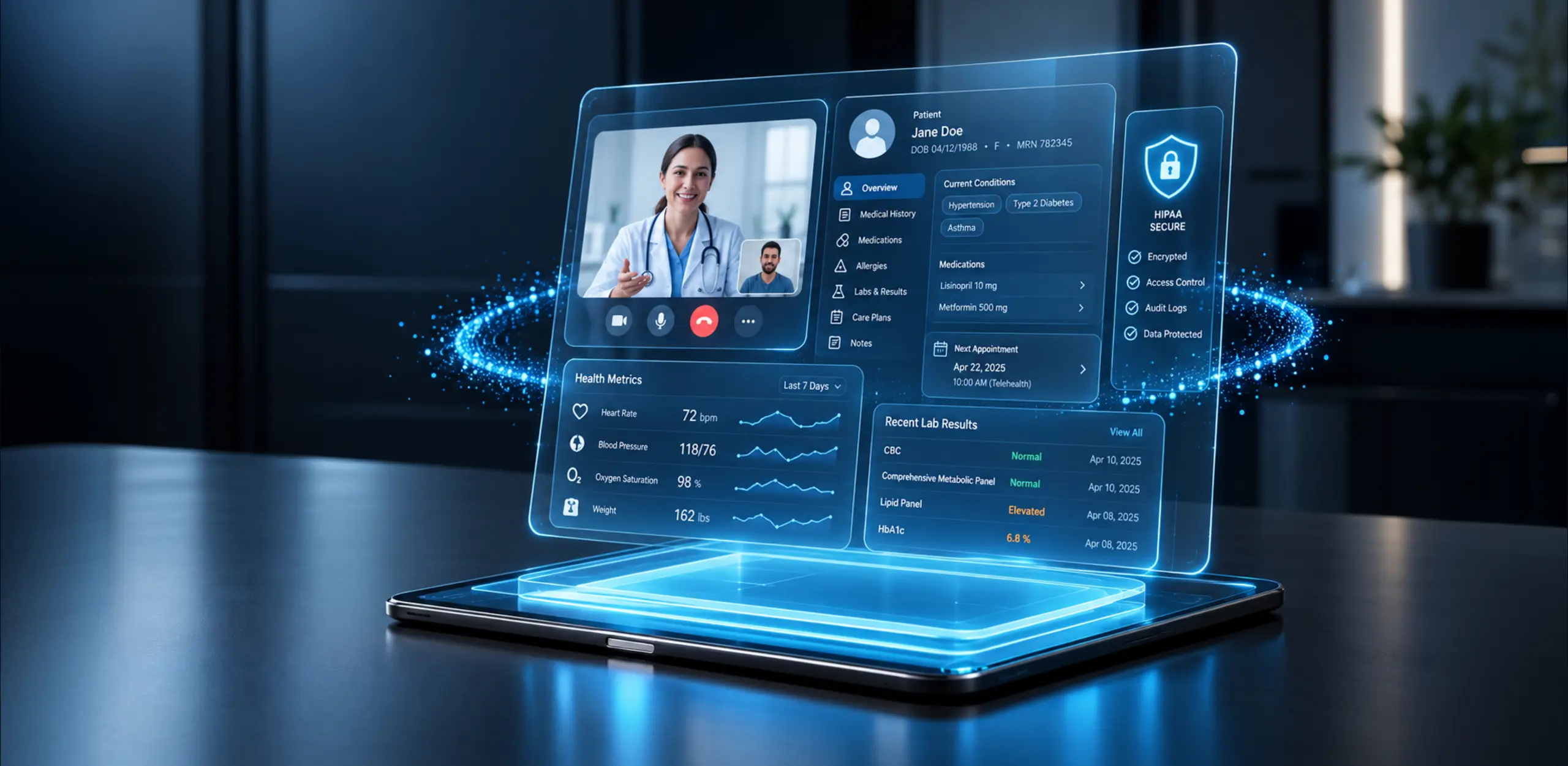

A video call that only connects two people is no longer enough. Businesses now need communication platforms that record what happened, summarise the conversation, protect sensitive data, support multilingual users, and connect outcomes to daily workflows. This is why WebRTC app development services in 2026 are no longer about building a basic meeting room. They are about building intelligent real-time communication platforms.
WebRTC provides the browser-based foundation for audio, video, and data exchange. AI adds the intelligence layer: transcription, meeting summaries, translation, moderation, sentiment signals, workflow automation, and smarter media optimisation. Together, they are changing what businesses expect from WebRTC application development.
For companies planning WebRTC app development services, the real question is not “Can we build a video call?” The better question is “Can our platform turn live conversations into secure, searchable, and actionable business intelligence?” That question matters for telemedicine, virtual classrooms, customer support, sales enablement, recruitment, enterprise collaboration, and live commerce.
The market direction supports this shift. WebRTC.org describes WebRTC as an open standard for real-time video, voice, and data. The W3C WebRTC specification defines browser APIs for media and generic application data. McKinsey’s 2025 global survey reported that 88% of organisations used AI in at least one business function. Fortune Business Insights projects the video conferencing market to grow from USD 41.62 billion in 2026 to USD 65.72 billion by 2034, while Persistence Market Research projects the WebRTC market to grow from USD 12.6 billion in 2026 to USD 89.1 billion by 2033.
This guide explains the AI-powered features modern platforms need, where WebRTC consulting services help, what Custom WebRTC app development services should include, and how to choose a video conferencing application development company that can build beyond a generic calling interface.
For more context on intelligent real-time communication, read AI and WebRTC: Future of Enhanced Communication Applications.
Explore how Enfin Technologies can help turn your WebRTC roadmap into an AI-ready communication product built for scale.
Explore Enfin’s AI-ready WebRTC solutions built for scale.
Why AI Is Changing WebRTC App Development Services
Traditional WebRTC application development focused on call joining, audio quality, video quality, screen sharing, recording, device handling, browser compatibility, and secure media transport. These features are still important, but they are now baseline expectations. The next layer of value comes from intelligence before, during, and after the session.
AI can convert speech to text, identify key points, generate action items, translate live conversations, reduce background noise, flag unsafe content, detect call quality risks, and push summaries into CRM, LMS, EHR, or helpdesk platforms. This turns WebRTC app development services from a technical implementation into a business transformation layer.
That is why WebRTC consulting services should start before development. A business needs to decide which AI features are genuinely useful, which data can be processed live, which data should be processed after the call, what must stay private, and where human review is required. The best Custom WebRTC app development services begin with those decisions, not with a long feature checklist.
This is also where AI development services should work alongside media engineering, so models, prompts, and workflows are designed around real product data instead of generic automation.
What Modern WebRTC Application Development Should Deliver
In 2026, WebRTC application development should support three connected layers.
The first layer is the real-time experience: audio, video, chat, screen sharing, recording, device selection, network resilience, TURN/STUN support, and secure media flow. The second layer is AI intelligence: transcription, summaries, translation, speaker labels, moderation, analytics, and meeting assistance. The third layer is workflow: CRM updates, classroom recaps, consultation notes, support tickets, compliance logs, and reporting dashboards.
This layered model helps businesses avoid weak video conferencing app development decisions. Adding AI for marketing appeal is not enough. Video conferencing software development must be mapped to real users. A doctor, teacher, agent, recruiter, sales manager, and compliance officer all need different outputs from the same live conversation.
A serious video conferencing application development company should therefore ask business questions before technical questions: Who joins the call? What data is sensitive? What happens after the call? Who can access summaries? Which integrations matter? How will success be measured?
AI-Powered Features Every Modern Platform Should Consider
1. Real-Time Transcription and Searchable Records
Real-time transcription is one of the most practical AI features in WebRTC app development services. It improves accessibility, helps users follow complex discussions, and creates searchable records for training, compliance, quality analysis, and knowledge management.
For WebRTC application development, transcription should include language support, speaker separation, consent messages, retention rules, export controls, and role-based access. In healthcare, finance, education, and enterprise communication, transcripts may contain sensitive information, so privacy is as important as accuracy.
2. AI Meeting Summaries and Action Items
AI summaries are now a mainstream expectation. Microsoft Teams provides intelligent recap features that help users find key information and follow-ups after meetings. Zoom AI Companion can generate meeting summaries when enabled. These features are training users to expect similar intelligence in custom platforms.
For businesses investing in WebRTC app development services, summaries reduce manual admin work and improve follow-through. In sales, they can update a CRM. In healthcare, they can support consultation notes. In education, they can turn live classes into revision assets. In customer support, they can create ticket notes and escalation records.
3. Live Translation and Multilingual Collaboration
Live translation is valuable for global teams, telemedicine platforms, e-learning providers, remote recruitment, international events, and customer support. AI can provide translated captions, multilingual transcripts, and post-call summaries in preferred languages.
In healthcare use cases, telemedicine app development needs secure video, consent, recording controls, EMR integration, and audit-ready AI summaries.
For Custom WebRTC app development services, translation must be handled carefully. Accuracy can change based on accent, language, audio quality, domain vocabulary, and model choice. Medical, legal, or financial conversations may need confidence indicators, verification workflows, and human review.
4. AI Noise Suppression and Voice Enhancement
Poor audio damages every real-time platform. Users join from homes, clinics, classrooms, warehouses, public spaces, and mobile networks. Background noise, echo, weak microphones, and unstable environments affect understanding and transcription accuracy.
AI noise suppression and voice enhancement improve call clarity, reduce listening fatigue, and support better records. In video conferencing software development, audio quality should be treated as a business requirement, not a minor technical detail.
5. Speaker Identification and Role-Aware Intelligence
AI becomes more useful when it understands who said what. Speaker identification helps produce accurate transcripts, role-based summaries, action items, and analytics. In a support call, the platform can separate agent and customer inputs. In a virtual classroom, it can separate instructor explanations and learner questions. In telemedicine, it can separate doctor, patient, and caregiver inputs.
This does not always require biometric identification. Many platforms can use role labels such as host, guest, teacher, learner, doctor, patient, agent, or customer. For WebRTC app development services, this improves the quality and usefulness of AI outputs.
6. AI Moderation and Compliance Support
As platforms scale, moderation becomes more important. Live sessions can include abusive language, spam, harassment, privacy violations, or unsafe behaviour. AI moderation can flag risks, alert moderators, create audit entries, or trigger escalation workflows.
A mature video conferencing application development company will not rely on blind automation. It will design moderation with human review, role-based rules, transparent policies, data retention controls, encryption, access permissions, and audit trails. This is especially important for healthcare, education, finance, and public-facing communities.
7. Sentiment Analysis and Conversation Intelligence
Sentiment analysis can help teams understand customer frustration, sales objections, learner confusion, or support escalation risk. However, sentiment is not absolute truth. It is a signal affected by culture, language, tone, noise, and context.
For WebRTC application development, conversation intelligence should be transparent and privacy-aware. Users and administrators should know what is analysed, why it is analysed, and how long the data is stored.
8. AI Assistants Inside Live Sessions
AI assistants can support users during live sessions by answering questions from approved knowledge bases, reminding hosts about agenda items, suggesting next steps, helping late joiners catch up, or routing users before a human joins.
In video conferencing development, the assistant must be permission-aware and grounded in verified data. If it interrupts too often, gives inaccurate answers, or exposes restricted information, it can reduce trust instead of improving the experience.
9. Predictive Network Quality and Media Optimisation
AI is also useful behind the scenes. Real-time platforms already depend on adaptive bitrate, simulcast, SFU routing, TURN optimisation, and network monitoring. AI can help identify patterns behind dropped calls, poor video quality, device failures, and geography-specific latency.
For enterprise video conferencing development, telemedicine, online learning, and customer support, these insights can reduce operational risk and improve platform reliability.
10. Post-Call Workflow Automation
The biggest value often appears after the call ends. A platform can automatically create support tickets, update CRM fields, generate consultation summaries, prepare lesson recaps, assign tasks, or notify the right team.
This is where Custom WebRTC app development services create an advantage over generic meeting tools. The platform is not just a place to talk. It becomes part of the business workflow.
Cost of WebRTC App Development Services in 2026
The cost of WebRTC app development services depends on complexity, architecture, AI requirements, compliance needs, integrations, and expected user load. A simple MVP with one-to-one calls, login, chat, and basic recording will cost less than an enterprise platform with SFU architecture, mobile apps, analytics, AI transcription, AI summaries, moderation, and workflow integrations.
A practical way to estimate cost is to split the platform into layers. The core WebRTC layer covers calling, signalling, media routing, device handling, recording, and security. The AI layer covers speech-to-text, summaries, translation, moderation, assistants, and analytics. The business layer covers dashboards, admin controls, CRM, LMS, EHR, helpdesk, billing, and reporting.
WebRTC consulting services can reduce cost by clarifying what should be built first. Many businesses do not need every AI feature in version one. They need a stable core, one or two high-value intelligence features, and a roadmap for expansion.
For a deeper budgeting view, read Cost of Building a Custom Video Conferencing App.
Need clarity before estimating budget? Talk to Enfin Technologies to validate the right MVP, architecture, and AI roadmap before WebRTC app development services begin.
Custom WebRTC App Development Services vs Off-the-Shelf Tools
Off-the-shelf meeting tools are useful for general collaboration. They are faster to adopt and often cheaper at the start. However, they can become limiting when a business needs custom workflows, branded user journeys, industry-specific compliance, advanced permissions, custom AI rules, deep integrations, or ownership of communication data.
Custom WebRTC app development services are better when communication is part of the product itself. Telemedicine platforms, virtual classrooms, interview platforms, support systems, live commerce experiences, and customer engagement tools usually need more control than generic meeting software can provide.
This is the difference between using a meeting tool and building a communication product. Video conferencing app development should not copy Zoom or Teams. It should solve a specific workflow better than a generic platform can.
Technology Stack for Modern WebRTC Application Development
A scalable platform usually includes client apps, signalling servers, SFU or media server infrastructure, TURN/STUN servers, authentication, permissions, recording pipelines, storage, analytics, monitoring, and API integrations.
Common WebRTC architecture choices include peer-to-peer for simple use cases, SFU for scalable group calls, MCU for selective mixed media scenarios, or hybrid models for advanced platforms. Technologies may include WebRTC APIs, Node.js, React, Flutter, native mobile SDKs, Coturn, Mediasoup, Janus, LiveKit, 100ms, AWS, Azure, Kubernetes, observability tools, and AI model integrations.
For scalability planning, read How a WebRTC App Development Company Build Scalable Real-Time Mobile and Web Apps.
The right stack depends on the product. WebRTC consulting services help choose the architecture before development mistakes become expensive.
Buyer Checklist for WebRTC and Video Conferencing Development
Before selecting a partner, check whether the WebRTC application development plan covers scalability, recording, security, AI outputs, and workflow integration. Ask whether the video conferencing app development roadmap separates MVP features from future enhancements. Review whether the video conferencing software development approach includes browser testing, mobile performance, call quality monitoring, and data protection. A strong video conferencing development team should also explain media server choices, TURN costs, AI model usage, and post-launch support. Most importantly, the video conferencing application development company should connect every feature to a business outcome, not just a technical specification.
How a WebRTC App Development Company Builds an AI-Powered Platform
A strong video conferencing application development company should follow a product-first process.
- Discovery: define users, business goals, compliance needs, call flows, AI features, and integrations.
- Architecture: choose peer-to-peer, SFU, MCU, or hybrid architecture; plan TURN/STUN, recording, security, and scalability.
- UX Design: design joining flows, permissions, device selection, call controls, captions, summaries, and admin views.
- Development: build the WebRTC core, backend services, dashboards, mobile or web apps, and integrations.
- AI Integration: add transcription, summaries, translation, moderation, assistants, and analytics where they create measurable value.
- Testing: validate browsers, devices, network conditions, audio quality, latency, AI accuracy, and access controls.
- Deployment and Support: monitor call quality, scale infrastructure, improve AI outputs, and support new features.
This process makes WebRTC app development services more predictable and reduces the risk of building features that look impressive but fail in real usage.
Why Choose Enfin Technologies for WebRTC App Development Services
Enfin Technologies brings experience across WebRTC, AI, telemedicine, video conferencing, education technology, real-time communication, and enterprise software. That combination matters because AI-powered communication platforms are not simple websites. They need media engineering, product thinking, AI integration, security, scalability, and long-term support.
Businesses choose Enfin for WebRTC app development services when they need more than a generic calling feature. They need a team that can understand the workflow, recommend the right architecture, integrate AI responsibly, and build a platform that supports growth.
Whether the requirement is WebRTC consulting services, Custom WebRTC app development services, video conferencing app development, video conferencing software development, video conferencing development, telemedicine communication, virtual classrooms, or enterprise collaboration, the goal should be the same: reliable real-time communication with intelligence that supports business outcomes.
Conclusion
AI is not replacing WebRTC. It is expanding what WebRTC platforms can do. Real-time audio and video remain the foundation, but the value now comes from what the platform understands, records, protects, and automates.
That is why WebRTC app development services in 2026 must be planned around communication quality, AI usefulness, privacy, compliance, workflow integration, and scalability. Not every platform needs every AI feature from day one. The smarter approach is to build a reliable core, add the highest-impact intelligence features, and expand based on real user behaviour.
For businesses building the next generation of communication products, AI-powered WebRTC can make calls more accessible, meetings more productive, consultations more useful, classrooms more engaging, and support conversations more actionable. The challenge is choosing the right product strategy, architecture, and development partner from the beginning.
Planning an AI-powered WebRTC platform?
Partner with Enfin Technologies for WebRTC app development services that combine real-time communication, AI integration, security, scalability, and industry-specific workflows. Talk to Enfin to move from basic video calls to intelligent, business-ready communication.
Let’s transform your business for a change that matters!
F. A. Q.
Do you have additional questions?
What are WebRTC app development services?
WebRTC app development services involve building real-time communication platforms with audio, video, messaging, screen sharing, recording, data exchange, security, and AI-powered features such as transcription, summaries, translation, moderation, and analytics.
Why are AI features important in WebRTC application development?
AI features make real-time platforms more useful after the conversation ends. They can create searchable transcripts, summaries, action items, support insights, learning records, and workflow updates.
When should a business use WebRTC consulting services?
WebRTC consulting services are useful before development starts, especially when the platform needs scalability, security, AI integration, recording, mobile support, compliance, or industry-specific workflows.
What is the difference between video conferencing app development and WebRTC application development?
WebRTC application development is the broader technical foundation for real-time audio, video, and data exchange. Video conferencing app development is a specific use case that includes meetings, rooms, screen sharing, recording, moderation, scheduling, and participant management.
Are Custom WebRTC app development services better than using Zoom or Teams?
Custom WebRTC app development services are better when communication is part of the product, when workflows must be branded, when data ownership matters, or when the platform needs custom AI, compliance, and integrations.
What AI features are useful in video conferencing software development?
Useful AI features in video conferencing software development include real-time transcription, meeting summaries, live translation, noise suppression, speaker identification, moderation, sentiment signals, AI assistants, and workflow automation.
How do I choose a video conferencing application development company?
Choose a video conferencing application development company with experience in WebRTC architecture, SFU/media servers, AI integration, cloud deployment, security, mobile performance, and post-launch support.
Can AI be added to an existing WebRTC app?
Yes. AI can be added to an existing WebRTC app through client-side processing, media server integration, or cloud-based AI pipelines. The best approach depends on the current architecture, privacy needs, and latency requirements.