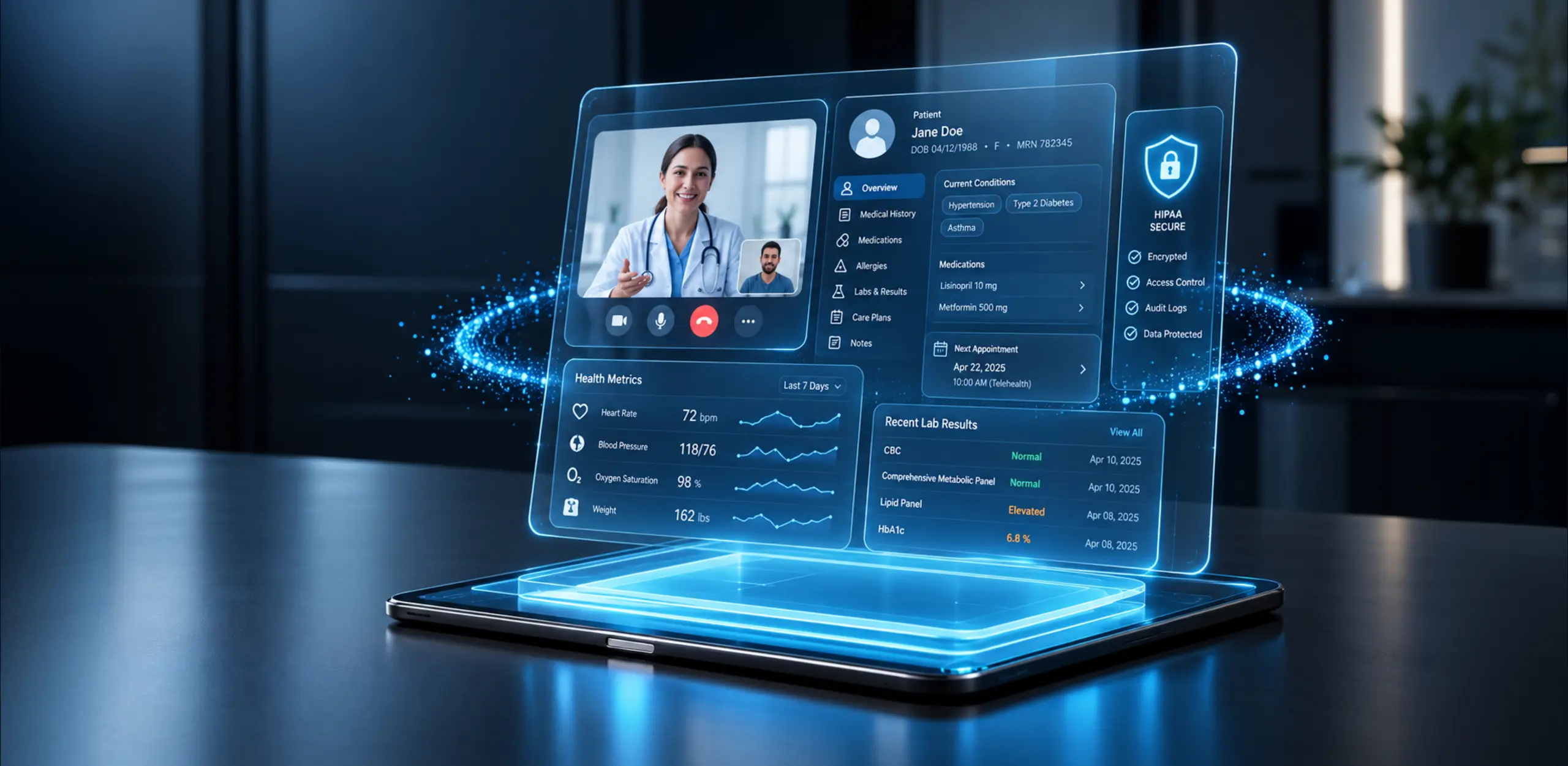

Real-time digital experiences are no longer a luxury. They have become the foundation of how businesses communicate, collaborate, teach, consult, diagnose, and engage users.Whether it is telemedicine, online learning, virtual events, fintech collaboration, gaming, customer support, or enterprise communication, users now expect interactions to happen instantly.
The shift toward real-time experiences is accelerating rapidly. Industry research projects the global WebRTC market to continue strong growth throughout this decade, driven by telemedicine, enterprise collaboration, customer engagement, virtual learning, and AI-powered communication experiences.
The business case for real-time communication continues to strengthen. Industry projections estimate the global WebRTC market could exceed $150–200+ billion by the early 2030s, fueled by telemedicine, virtual classrooms, embedded communication, customer engagement, and enterprise collaboration platforms. At the same time, customer expectations are rising. Studies consistently suggest that users increasingly prefer instant, real-time support and communication experiences over delayed or asynchronous engagement.
For businesses, this means communication quality is no longer just a feature, it directly impacts trust, retention, and customer experience.
Consumer expectations are changing just as quickly. Research consistently shows that users increasingly abandon poor digital experiences when latency, buffering, or communication quality becomes frustrating. In video communication, delays beyond a few hundred milliseconds can noticeably disrupt natural conversation.
In simple terms:
Users no longer compare your product only with competitors.They compare your communication experience with Zoom, Google Meet, WhatsApp, Microsoft Teams, and FaceTime.
This shift has created a major demand for a WebRTC app development company that can engineer fast, reliable, secure, and scalable real-time applications across mobile and web platforms. But building a real-time communication platform is not as simple as adding video calling APIs or embedding a meeting feature.
Modern businesses need:
- Ultra-low latency communication
- Seamless mobile and web experiences
- High concurrency support
- Security and compliance readiness
- Scalable infrastructure
- Adaptive performance in unstable networks
- AI-enhanced communication experiences
This is where a WebRTC app development company plays a critical role.
The best teams do far more than simply integrate WebRTC into an application. They architect scalable systems, optimize media delivery, handle signaling, improve resilience under network failures, and create communication experiences that work reliably even when thousands of users join simultaneously.
In this guide, we explore how WebRTC app development companies build real-time apps, what makes scalable architectures possible, and why businesses increasingly rely on specialized WebRTC development services to create next-generation communication experiences.
Partner with Enfin Technologies for secure, scalable WebRTC app development.
Why Businesses Need Scalable Real-Time Communication Solutions
Today’s digital users have little patience for delays. If a video freezes during a doctor’s consultation, a patient loses trust. If audio breaks during an online classroom, student engagement drops instantly.
If a financial consultation lags during a critical transaction, customer confidence disappears.
Studies across digital experience platforms repeatedly show that performance quality directly influences engagement and retention.
For businesses investing in real-time communication solutions, even small disruptions matter.
In real-time communication environments, milliseconds matter more than many businesses initially expect.Engineering benchmarks commonly referenced across RTC systems suggest:
- End-to-end latency below ~300 milliseconds generallyfeelsnatural for conversation.
- Delays above ~500 milliseconds can begin disrupting interaction flow.
- Packet loss above 1–2% can noticeably reduce perceived call quality.
This is why businesses are prioritizing real-time communication solutions that can scale without sacrificing quality.
A modern WebRTC app development company understands that scalability is not simply about adding more servers.
True scalability means:
- Maintaining consistent call quality during traffic spikes
- Reducing latency under heavy loads
- Supporting thousands of simultaneous users
- Handling device fragmentation on mobile
- Delivering cross-browser compatibility
- Maintaining secure peer-to-peer communication
- Optimizing infrastructure cost
This is one reason organizations increasingly partner with a WebRTC development company instead of depending entirely on generic communication platforms.
The goal is not just communication; The goal is business continuity, engagement, retention, and growth.
How WebRTC App Development Companies Build Scalable Real-Time Apps
A skilled WebRTC app development company follows a systematic engineering process instead of treating communication as a plug-and-play feature.
1. Understanding the Communication Use Case
The first step in WebRTC app development is understanding exactly how people communicate inside the product.
A healthcare consultation platform behaves differently from a live classroom.
A customer support platform behaves differently from a social video application.
For example:
Telemedicine
Needs:
- Low latency
- HIPAA readiness
- Screen sharing
- Recording
- High security
E-learning
Needs:
- Breakout rooms
- Moderator control
- Polls
- Collaborative tools
- Session recording
Fintech
Needs:
- End-to-end encryption
- Regulatory compliance
- Stable connectivity
- Identity verification
This discovery stage helps a WebRTC app development company choose the right architecture before development begins.
2. Designing the Right WebRTC Architecture for Mobile Applications and Web Platforms
A major reason applications fail is poor architecture decisions. A scalable WebRTC app development company carefully designs the media architecture depending on expected traffic and business goals.
Mesh Architecture
Every participant connects directly.
Best for:
- Small meetings
- One-to-one communication
Challenge: Poor scalability.
MCU (Multipoint Control Unit)
Media is mixed centrally.
Best for:
- Controlled enterprise environments
- Recording-heavy platforms
Challenge: Higher server cost.
SFU (Selective Forwarding Unit)
The most common architecture for scalable apps.
Best for:
- E-learning
- Telemedicine
- Enterprise meetings
- Live communication
A modern WebRTC development company often recommends SFU because it provides scalability without overwhelming devices. This architecture enables a scalable WebRTC app development company to support thousands of concurrent users.
As applications grow from a few participants to thousands of concurrent users, architectural decisions become increasingly important. Factors such as SFU vs MCU selection, bandwidth optimisation, latency management, and media routing directly influence scalability and user experience. For a deeper technical perspective, explore our guide on WebRTC scaling architectures for live streaming and large-scale group communication, where we break down how scalable RTC systems are engineered
3. Building Reliable Signaling Systems
Many businesses underestimate signaling.
WebRTC does not define signaling itself.
This means a WebRTC app development company must engineer the logic responsible for:
- Session creation
- User discovery
- Authentication
- Offer/answer exchange
- Call reconnect logic
- Presence management
Without optimized signaling, even powerful communication platforms fail under traffic spikes.
Modern custom WebRTC app development typically uses:
- WebSockets
- Socket.IO
- MQTT
- gRPC-based communication
4. Solving Mobile Network Challenges
One overlooked reality in WebRTC mobile and web app development is unstable internet quality.
Mobile users constantly switch between:
- Wi‑Fi
- 5G
- 4G
- weak cellular zones
Research consistently shows that users frequently move between multiple network conditions during a single session, particularly in mobile-first markets.
A professional WebRTC app development company prepares applications for poor network conditions.
Advanced optimizations include:
Adaptive Bitrate Streaming
The app automatically adjusts quality. This ensures communication continues even when bandwidth suddenly drops.
Packet Loss Recovery
Missing packets are intelligently handled. Even minor packet loss can reduce call quality significantly.
Network Resilience Logic
Calls reconnect smoothly. Strong reconnect logic is essential because unexpected disconnections directly impact retention.
Dynamic Codec Selection
The system switches formats depending on bandwidth. These optimisations make a major difference in user retention. The reality is simple: Users rarely blame their internet. They blame the app.
This challenge becomes even more important in mobile-first regions such as India, where bandwidth variability, device fragmentation, and network switching are significantly more common. In these environments, low-bandwidth optimization, adaptive bitrate streaming, reconnect resilience, and lightweight. Give the name of the section where this is to beadded
The Hidden Engineering Behind Scalable Real-Time Mobile and Web Apps
Many businesses think scaling real-time communication simply means adding cloud resources. In reality, a WebRTC app development company solves much deeper engineering challenges.
TURN and STUN Optimization
Firewalls and NAT restrictions often block peer communication.
A WebRTC development company uses:
- STUN servers for public address discovery
- TURN servers for media relay
Poor TURN optimization increases cost dramatically. The best real-time video app development company focuses heavily on minimizing relay dependency.
Load Balancing for Media Servers
Modern WebRTC development services distribute traffic across multiple SFU instances. This prevents overload.
Advanced systems use:
- Geographic routing
- Kubernetes auto-scaling
- Region-aware media distribution
- Edge-based processing
Latest and Lesser-Known Advancements in WebRTC (2025–2026)
Most blogs stop at video calling.
But modern WebRTC app development has evolved significantly. Today, the difference between an average communication product and a category leader often comes down to engineering sophistication.
Industry analysts estimate that real-time communication-powered digital experiences are becoming foundational across healthcare, education, customer support, finance, and enterprise collaboration. Video-first applications continue to grow rapidly as businesses increasingly prioritize user engagement, faster decision-making, and distributed collaboration.
A modern WebRTC app development company now focuses on performance intelligence, AI-enhanced communication, lower latency, bandwidth efficiency, and scalable infrastructure.
What many businesses still underestimate is how quickly expectations around communication quality are evolving. Users increasingly compare communication experiences against products such as Zoom, Google Meet, Microsoft Teams, and FaceTime. This means even technically functional communication products may still fail if latency, video quality, or resilience feels noticeably inferior.
AI-Powered Communication Optimization
Leading WebRTC app development companies build real-time apps using AI for:
- Background noise removal
- Voice isolation
- Smart bandwidth adaptation
- Real-time language translation
- Speaker tracking
- Echo cancellation enhancement
- Live meeting intelligence
Studies across collaboration platforms show that poor audio quality is one of the biggest causes of meeting fatigue and session abandonment. Even a few seconds of disruption can negatively affect engagement during learning, healthcare, or enterprise communication.
This is why a modern WebRTC app development company increasingly integrates AI-powered communication enhancement into real-time communication solutions.
AV1 Codec Adoption
AV1 is helping businesses reduce bandwidth usage while maintaining quality.
Compared with older codecs, AV1 can improve compression efficiency substantially, allowing platforms to deliver better video quality at lower bandwidth consumption. For businesses running large-scale communication products, bandwidth optimization directly affects infrastructure cost.
For example:
A platform serving thousands of concurrent users may significantly reduce media delivery expenses through efficient codec strategies.
A forward-thinking WebRTC development company increasingly evaluates AV1 for:
- Large-scale video conferencing
- E-learning platforms
- Telemedicine systems
- Streaming-heavy collaboration platforms
Edge Media Processing
Instead of centralized processing, media increasingly gets handled closer to users.
Benefits include:
- Lower latency
- Better quality
- Reduced congestion
- Faster reconnect time
For global products, milliseconds matter.
Research consistently shows that latency beyond a few hundred milliseconds noticeably impacts conversation quality and user satisfaction. This becomes even more important in WebRTC mobile and web app development, where users operate across unpredictable networks.
GPU-Powered RTC Infrastructure
Modern infrastructure increasingly uses GPU acceleration for:
- Video compositing
- Recording
- AI enhancement
- Live effects
- Real-time media optimization
GPU acceleration is particularly valuable when handling high-resolution video, large classrooms, or multi-stream conferencing environments.
A scalable WebRTC app development company often evaluates whether GPU workloads can improve efficiency and reduce server bottlenecks.
Security: The Part Businesses Usually Ignore
Security is one area where inexperienced teams fail. A trusted WebRTC app development company builds communication systems with security from day one. This matters because users increasingly expect privacy, secure communication, and enterprise-grade trust. Research across industries consistently shows that trust and data security directly influence adoption, particularly in healthcare, education, fintech, and enterprise communication.
Key considerations include:
Encryption
WebRTC supports:
- SRTP
- DTLS
These protocols help secure media transmission.
Identity Verification
Strong authentication matters.
Compliance
Depending on industry:
- HIPAA
- GDPR
- SOC 2
Healthcare organizations increasingly prioritize HIPAA-ready communication. Similarly, GDPR expectations continue shaping digital communication strategies in global markets.
A strong WebRTC development company treats compliance as infrastructure, not an afterthought.
Common Mistakes Businesses Make While Building Real-Time Apps
Many businesses underestimate the complexity of building communication systems. One of the biggest misconceptions is assuming that real-time communication is simply a feature.
In reality, scalable communication products behave like distributed systems. They involve networking, media optimization, infrastructure orchestration, security, and resilience engineering. A trusted WebRTC app development company understands that poor architectural decisions early in the process can become extremely expensive later.
According to engineering observations across the RTC ecosystem, businesses frequently underestimate how quickly infrastructure costs rise when media relay, TURN dependency, and scaling are poorly planned.
Here are some common mistakes organizations make:
1. Choosing Generic SDKs Too Early
Generic communication APIs are useful for MVPs.
However, as applications mature, businesses often face:
- Rising usage costs
- Vendor lock-in
- Limited customization
- Restricted performance optimization
This is one reason enterprises eventually move toward custom WebRTC app development.
2. Ignoring Scalability Planning
Many startups optimize for 100 users.
Then suddenly growth happens.
The system struggles with:
- Session instability
- Server overload
- Increased latency
- Failed reconnections
A professional WebRTC app development company plans for scalability from day one.
3. Underestimating Mobile Network Instability
Mobile communication environments are unpredictable.
Users constantly switch between Wi‑Fi, 5G, and weaker cellular networks.
A strong WebRTC app development company prioritizes adaptive bitrate, reconnect logic, packet loss recovery, and dynamic optimization.
4. Weak TURN Optimization
TURN traffic is expensive. If media relay dependency becomes too high, infrastructure cost rises rapidly. Experienced WebRTC development services teams focus heavily on TURN optimization to reduce unnecessary relay usage.
5. Ignoring Compliance Requirements
Healthcare, fintech, and enterprise applications often require:
- HIPAA readiness
- GDPR compliance
- Secure data transmission
- Audit logging
A reliable WebRTC development company considers compliance during architecture planning.
6. No Fallback Communication Strategy
Poor internet happens.
Great products degrade gracefully.
Examples include:
- Switching to audio-only mode
- Dynamic bitrate reduction
- Reconnect optimization
- Adaptive video quality
7. Poor Infrastructure Cost Planning
Businesses often focus only on development cost. However, media delivery, scaling, and bandwidth expenses become major long-term considerations.
This is where a scalable WebRTC app development company adds significant value.
Avoid costly RTC rebuilds later. Build your WebRTC foundation right from day one with Enfin Technologies.
Questions to Ask Before Hiring a WebRTC App Development Company
Choosing a partner for WebRTC app development is a long-term technology decision. The wrong team may build features. The right WebRTC app development company builds communication infrastructure that supports business growth for years.
Here are questions decision-makers should ask:
Have You Built High-Concurrency Communication Systems?
Ask for real experience. Building a video chat app for 50 users is completely different from supporting thousands of concurrent sessions.
A reliable real-time video app development company should explain:
- Concurrency limits
- Scaling methods
- Media server architecture
- Real-world optimization experience
Beyond technology expertise, the quality of developers building your platform can significantly influence scalability, latency optimization, security, and long-term maintainability. Businesses evaluating technical capability should also understand why hiring specialized developers matters. Our guide on why hiring video streaming app developers leads to the best solutions explains how experienced real-time communication engineers can directly impact product success.
What Architecture Do You Recommend?
An experienced WebRTC development company should clearly explain:
- Mesh architecture
- SFU architecture
- MCU architecture
And more importantly: Why one option fits your business model better.
How Do You Handle TURN Costs?
TURN usage directly affects operational cost. Ask how the company minimizes unnecessary media relay dependency.
Strong WebRTC development services teams optimize:
- NAT traversal
- Relay routing
- Network fallback strategies
How Do You Optimize Mobile Performance?
A mature WebRTC app development company should discuss:
- Adaptive bitrate
- Packet loss handling
- Network switching resilience
- Low-bandwidth optimization
This matters enormously in WebRTC architecture for mobile applications.
How Do You Reduce Latency?
Latency directly impacts user experience.
Ask about:
- Edge media routing
- Regional infrastructure
- CDN-assisted signaling
- Media optimization strategies
What Security Practices Do You Follow?
Trustworthy companies should discuss:
- Encryption protocols
- Authentication
- Access control
- Compliance readiness
Can the Platform Scale Globally?
Growth changes everything. A future-ready WebRTC app development company plans infrastructure that supports:
- Geographic expansion
- High concurrency
- Multi-region deployment
- Cost-efficient scaling
Why Custom WebRTC App Development Matters
Businesses increasingly realize that generic communication platforms are not always enough. Yes, off-the-shelf tools help organizations move quickly. But over time, limitations appear.
This is where custom WebRTC app development becomes a strategic investment.
A specialized WebRTC app development company can design communication experiences around business workflows instead of forcing workflows to adapt to generic software. Research consistently suggests that customer experience increasingly influences retention, loyalty, and conversion.
In real-time communication, experience quality matters even more. Poor video quality, dropped sessions, weak moderation tools, and latency issues can directly affect user trust.
For example:
A telemedicine platform may need:
- Prescription workflows
- EHR integration
- HIPAA-ready communication
- Session recording
An education platform may require:
- Breakout rooms
- AI participation tracking
- Moderation tools
- Whiteboards
- Polls
A fintech platform may prioritize:
- Identity verification
- Secure onboarding
- Audit-ready communication
- Low-latency collaboration
Custom systems also offer long-term cost advantages.
While prebuilt communication APIs may seem cheaper initially, infrastructure cost at scale often becomes unpredictable.
Many fast-growing companies eventually transition toward custom WebRTC app development to improve:
- Cost control
- Flexibility
- Branding
- Data ownership
- Security
- Product differentiation
According to multiple industry estimates, customer experience increasingly influences retention, conversion, and loyalty.
Real-time engagement is now becoming a competitive differentiator.
A future-ready WebRTC app development company helps businesses create communication systems that evolve alongside product growth instead of becoming limitations later.
While WebRTC powers real-time, two-way communication, many businesses also need live streaming, OTT, or video-on-demand capabilities as part of their broader digital experience. For businesse Communication s exploring that direction, our guide on choosing the best video streaming app development company explains what to evaluate before building a scalable streaming platform.
What Scalable WebRTC Looks Like in Practice
Scalable communication systems rarely look identical because architecture depends heavily on business goals.
For example:
E-Learning Platforms
A virtual classroom supporting thousands of concurrent learners may prioritize:
- SFU-based architecture
- Breakout rooms
- Moderator controls
- Adaptive bitrate streaming
- Recording optimization
Telemedicine Platforms
A telehealth product may prioritize:
- Low-latency communication
- Encrypted sessions
- HIPAA-ready workflows
- Secure patient access
- Reconnect resilience
Fintech Systems
Financial communication platforms may prioritize:
- Identity verification
- Secure onboarding
- Audit-ready interactions
- Encrypted communication
- Compliance-driven architecture
This is why experienced WebRTC app development companies rarely recommend one-size-fits-all communication architectures.
Final Thoughts
The future of digital experiences is real time. Businesses no longer compete only through features. They compete through interaction quality, reliability, and speed.
Users expect seamless communication whether they are learning, consulting, shopping, collaborating, or receiving healthcare. This is why choosing the right WebRTC app development company matters more than ever. The best teams do not simply build video calling features.
They architect scalable, secure, resilient communication ecosystems designed for long-term business growth.
Whether you are building telemedicine systems, e-learning platforms, enterprise collaboration products, customer engagement tools, or next-generation communication platforms, investing in expert WebRTC development services becomes a strategic advantage.
Organizations that prioritize scalability, performance, and communication quality today will be the ones delivering superior digital experiences tomorrow.
If your business is planning to build secure and scalable real-time communication solutions, partnering with an experienced WebRTC development company can significantly accelerate time-to-market while reducing technical risk.
Let’s transform your business for a change that matters!
F. A. Q.
Do you have additional questions?
What does a WebRTC app development company do?
A WebRTC app development company builds real-time communication solutions for mobile and web applications using WebRTC technology. This includes video calling, audio communication, screen sharing, live collaboration, signaling systems, STUN/TURN setup, SFU/MCU architecture, security, and performance optimization. A reliable WebRTC development company also helps businesses design scalable infrastructure for long-term growth.
How do WebRTC app development companies build real-time apps?
WebRTC app development companies build real-time apps by combining media server architecture, signaling logic, adaptive bitrate streaming, TURN/STUN optimization, security protocols, and cloud infrastructure. The process usually includes requirement analysis, architecture planning, WebRTC app development, testing, scaling, and deployment across mobile and web platforms.
Why should businesses choose custom WebRTC app development?
Businesses choose custom WebRTC app development when they need full control over user experience, branding, workflows, scalability, security, and integrations. Unlike generic video APIs, custom WebRTC app development allows companies to build real-time communication solutions tailored for telemedicine, e-learning, fintech, customer support, gaming, and enterprise collaboration.
What makes a scalable WebRTC app development company different?
A scalable WebRTC app development company does more than build video calling features. It designs architecture that can handle high concurrency, low latency, packet loss recovery, adaptive streaming, media routing, TURN optimization, and multi-region deployment. This makes the application reliable even when user traffic grows significantly.
Why is WebRTC mobile and web app development important?
WebRTC mobile and web app development is important because users expect seamless communication across browsers, Android devices, iOS devices, tablets, and desktops. A professional WebRTC app development company ensures cross-platform compatibility, stable performance, low-bandwidth optimization, and consistent real-time communication across different devices and network conditions.
What is the best WebRTC architecture for mobile applications?
The best WebRTC architecture for mobile applications depends on the use case. Mesh architecture may work for small one-to-one calls, while SFU architecture is often preferred for scalable video conferencing, e-learning, telemedicine, and enterprise collaboration. A WebRTC development company evaluates user volume, device limitations, bandwidth, recording needs, and latency goals before choosing the architecture.
How do WebRTC development services improve real-time communication solutions?
Professional WebRTC development services improve real-time communication solutions by optimizing latency, video quality, audio clarity, reconnection logic, security, infrastructure scaling, and media server performance. These services help businesses avoid common issues such as dropped calls, poor video quality, high TURN costs, and unstable mobile experiences.
How is a WebRTC app development company different from a real-time video app development company?
A WebRTC app development company specializes in WebRTC-based communication systems, including peer-to-peer media, signaling, STUN/TURN, SFU/MCU architecture, and browser-native communication. A real-time video app development company may work with broader streaming, video conferencing, live video, or communication technologies. In many cases, an experienced company offers both WebRTC app development and real-time video app development expertise.
What industries benefit most from WebRTC app development?
Industries that benefit most from WebRTC app development include healthcare, e-learning, fintech, customer support, SaaS platforms, online marketplaces, gaming, virtual events, and enterprise collaboration. These industries use real-time communication solutions to improve engagement, reduce delays, support remote interaction, and create better digital experiences.
How do I choose the right WebRTC development company?
To choose the right WebRTC development company, evaluate its experience in WebRTC app development, scalable architecture, mobile and web performance, security, compliance, TURN/STUN optimization, SFU/MCU implementation, and post-launch support. The right WebRTC app development company should understand both technical architecture and business growth goals.