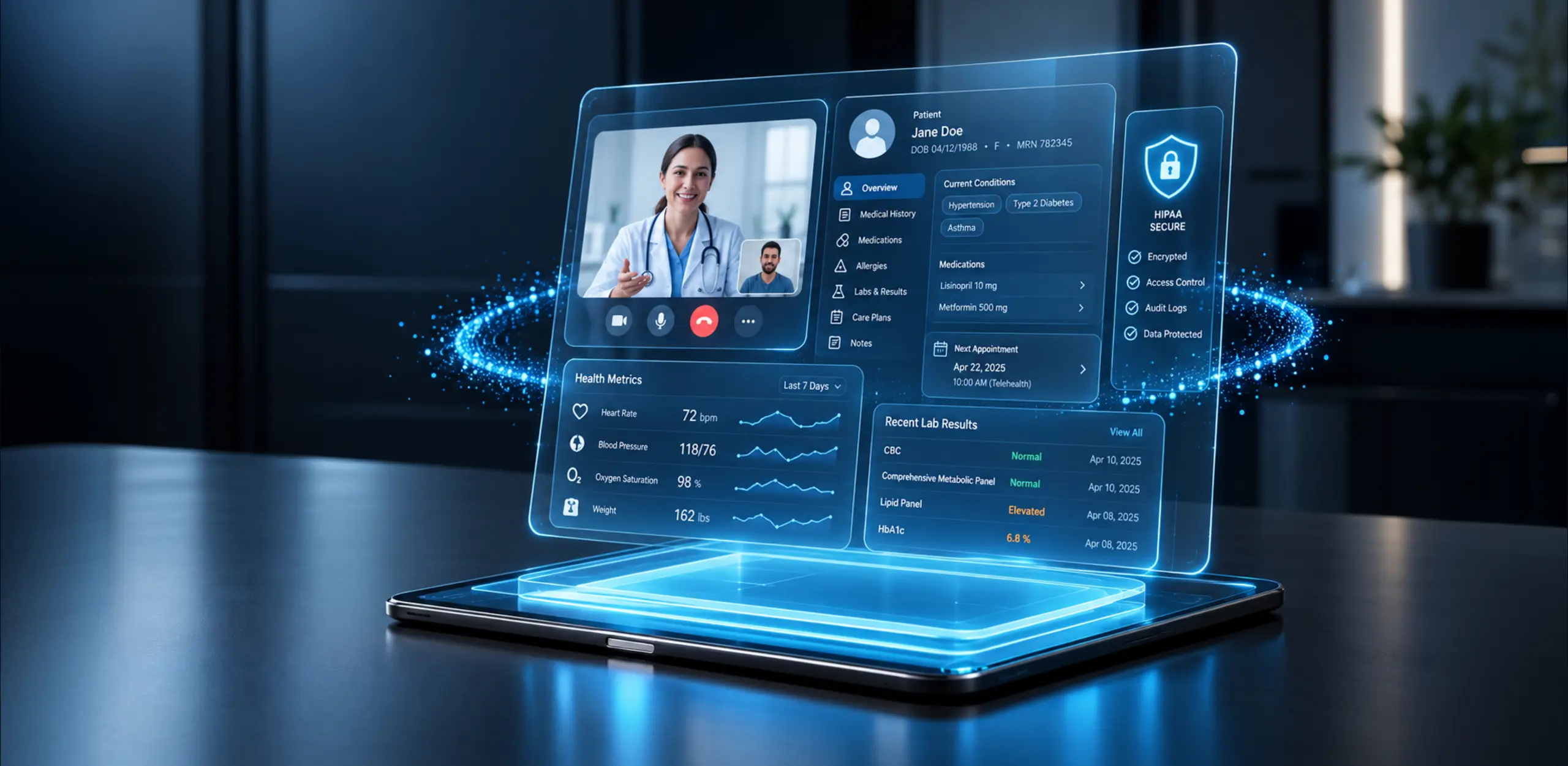

Over the last few years, patient behavior, healthcare infrastructure, and digital expectations have shifted simultaneously. What began as a necessity during global health crises has now evolved into a preferred mode of care delivery. Patients today expect healthcare to be as accessible as ordering a service online, instant, seamless, and reliable.
Let’s ground this transformation in real-world data:
- The global telehealth market is expected to reach $219+ billion in 2025 and cross $1 trillion by 2032
- Over 71% of physicians now use telehealth weekly, compared to just 25% in 2018
- More than 116 million people globally use online doctor consultations, doubling since 2019
- In the U.S. alone, 54% of patients used telehealth in the past year
This growth is not just adoption; it is dependency. Healthcare systems are now actively relying on digital platforms to deliver timely care.
And that changes everything.
A telehealth development company today is not just building applications; it is building mission-critical healthcare infrastructure. These platforms must function under pressure, adapt to unpredictable demand, and deliver consistent performance regardless of user conditions.
Unlike traditional software, telehealth systems operate in environments where every interaction has consequences. A delayed consultation can lead to miscommunication. A system crash can disrupt care delivery. A lag in data transmission can impact clinical decisions.
This is why performance is no longer a “nice-to-have” feature; it is a fundamental requirement.
Build healthcare platforms that perform under pressure.
What Makes High-Performance Telehealth Applications Truly “High-Performance”?
Most discussions around performance focus on speed alone. However, in telehealth, performance is multidimensional. A leading telemedicine app development company evaluates performance through a holistic lens that combines technical efficiency with clinical reliability.
Latency Under Clinical Pressure
Latency in telehealth is not just a technical metric, it directly impacts communication quality between doctors and patients. Even minor delays can disrupt conversational flow, making it harder for healthcare professionals to assess patient conditions accurately.
Doctors rely heavily on:
- Subtle facial expressions
- Tone and clarity of voice
- Immediate responsiveness
To maintain clinical effectiveness, high-performance telehealth applications aim for sub-150ms latency in real-time interactions. Achieving this requires optimized network routing, intelligent bandwidth management, and advanced streaming protocols.
Concurrent Scalability
Healthcare demand is inherently unpredictable. Seasonal illnesses, public health emergencies, and sudden spikes in consultations can place immense pressure on systems.
A modern telehealth development company must design platforms that can:
- Handle thousands of concurrent users
- Maintain consistent performance during peak loads
- Scale dynamically without manual intervention
With telehealth demand growing at a rapid pace globally, scalability is not optional, it is a core design requirement.
Clinical Reliability
Reliability in telehealth goes beyond uptime. It ensures that the system performs consistently across different conditions, devices, and network environments.
For healthcare platforms, reliability translates to:
- Minimal downtime (targeting 99.99% uptime)
- Seamless session continuity
- Automatic failover mechanisms
A telehealth development company must design systems that remain stable even when underlying components fail.
Regulatory-Grade Security
Security is foundational in healthcare technology. Patient data is highly sensitive, and any breach can have serious legal and ethical implications.
A trusted telemedicine app development company ensures:
- End-to-end encryption of all communications
- Secure authentication and authorization mechanisms
- Compliance with global standards such as HIPAA and GDPR
Security is not an add-on, it is deeply embedded into the architecture of high-performance telehealth applications.
Data Integrity and Real-Time Synchronization
Telehealth platforms manage a wide range of data, from patient records and prescriptions to real-time monitoring inputs.
Ensuring data integrity involves:
- Accurate data synchronization across systems
- Real-time updates during consultations
- Consistent data availability across devices
A robust telehealth development company ensures that healthcare providers always have access to reliable and up-to-date information.
The Real Challenge: Telehealth Is Not a Tech Problem; It’s a Systems Problem
One of the most overlooked aspects of telehealth development is that failures rarely occur due to a single issue. Instead, they are often the result of multiple interconnected challenges.
For instance:
- Poor network conditions can affect video quality
- Inefficient workflows can slow down consultations
- Lack of scalability can lead to system crashes during peak usage
Research highlights that common barriers to telehealth adoption include:
- Connectivity issues
- Workflow inefficiencies
- Limited digital literacy among users
A forward-thinking telehealth development company does not design systems for ideal scenarios. Instead, it builds solutions that perform reliably under real-world constraints. For a deeper understanding of how custom telehealth platforms are designed to address real-world healthcare challenges, explore our detailed guide on custom telehealth software development for healthcare providers.
Best Practices for Telehealth App Development
Architecting for Failure, Not Just Success
Traditional applications are often designed for optimal conditions. Telehealth systems, however, must be prepared for failures.
A resilient architecture includes:
- Multi-region deployments to ensure availability
- Circuit breaker patterns to prevent cascading failures
- Graceful degradation (e.g., switching from video to audio)
- Load management strategies
By anticipating failures, a telehealth development company ensures uninterrupted service delivery.
Hybrid Real-Time Communication Architecture
Real-time communication is at the heart of telehealth. While WebRTC is widely used, relying on a single technology is not sufficient for large-scale systems.
A modern approach combines:
- WebRTC for low-latency interactions
- HLS or LL-HLS for scalable streaming
- SFU (Selective Forwarding Units) for multi-party communication
This hybrid model ensures that high-performance telehealth applications can deliver both real-time responsiveness and large-scale reliability.
Data Layer Optimization
Performance issues in telehealth platforms often originate from the data layer. Efficient data handling is critical for maintaining system responsiveness.
Best practices include:
- Using CQRS to separate read and write operations
- Implementing distributed caching systems
- Optimizing database queries and indexing
A well-optimized data layer ensures faster response times and improved user experience.
AI-Augmented Telehealth Systems
Artificial intelligence is transforming telehealth by enhancing both performance and functionality.
Modern telehealth app development services leverage AI for:
- Automated patient triage
- Symptom analysis using NLP
- Predictive analytics for proactive care
AI not only improves efficiency but also enhances the quality of healthcare delivery.
Observability and Real-Time Monitoring
Performance cannot be improved without measurement.
A robust observability framework tracks:
- Video session quality
- Latency metrics
- API response times
- Error rates
This allows a telehealth development company to identify and resolve issues proactively.
Technology Stack That Powers High-Performance Telehealth Applications
The choice of technology directly impacts performance, scalability, and reliability.
A typical stack includes:
Frontend Layer
Modern frameworks like React and Next.js enable responsive, user-friendly interfaces that adapt seamlessly across devices.
Backend Layer
Scalable backend technologies such as Node.js and FastAPI support high concurrency and efficient API management.
Real-Time Layer
WebRTC combined with SFU solutions ensures low-latency communication.
Cloud Infrastructure
Cloud platforms provide the flexibility to scale resources dynamically and maintain high availability.
Data Layer
A combination of relational and non-relational databases ensures efficient data storage and retrieval.
Together, these technologies enable the development of high-performance telehealth applications that meet modern healthcare demands.
Key Components of High-Performance Telehealth Applications
Component | Impact |
WebRTC | Real-time communication |
Cloud Infrastructure | Scalability and uptime |
AI Integration | Automation and efficiency |
UX Design | Faster interactions |
Security & Compliance | Data protection |
Cost vs ROI: Building High-Performance Telehealth Applications
Investing in telehealth app development services requires upfront planning, but the long-term returns are significant.
Organizations typically achieve:
- 20–30% reduction in operational costs
- 2–3x increase in patient reach
- Improved consultation efficiency and reduced no-show rates
A reliable telemedicine app development company ensures that performance investments translate into measurable outcomes. If you’re evaluating the financial side of building a telehealth platform, our detailed breakdown of Telemedicine software development cost Guide 2026: Pricing in the US, India & UAE can help you understand pricing across the US, India, and the UAE.
User Experience as a Performance Multiplier
Performance in telehealth is not only measured in milliseconds, it is also measured in how fast, clear, and stress-free the experience feels to the user. In healthcare, perception matters just as much as actual system speed. A platform may be technically fast, but if users feel confused, delayed, or overwhelmed, the experience is still perceived as poor.
A mature telehealth development company understands that user experience (UX) is a direct contributor to performance. In fact, several studies in digital product design show that perceived performance can improve user satisfaction by up to 30–40%, even without major backend changes.
In telehealth, where users may already be anxious or unwell, UX becomes even more critical. A well-designed interface reduces hesitation, builds trust, and enables faster decision-making, effectively “accelerating” the experience without changing the underlying system.
Reducing Cognitive Load
Cognitive load refers to the mental effort required to use an application. In telehealth, minimizing this effort is essential because users are often dealing with health concerns, not technology.
A thoughtfully designed platform ensures that users do not have to “figure things out.” Instead, the system guides them naturally through each step.
A telemedicine app development company focuses on:
- Clear, intuitive navigation with minimal steps to complete key actions
- Prominent call-to-action buttons like “Book Appointment” or “Join Consultation”
- Pre-filled forms and smart suggestions to reduce typing effort
- Visual cues and progress indicators to guide users
For example, instead of presenting multiple options on a single screen, high-performing platforms use progressive disclosure, showing only what is necessary at each step. This reduces confusion and speeds up interactions.
Reducing cognitive load directly impacts performance because:
- Users complete tasks faster
- Errors are minimized
- Support queries are reduced
In essence, a simpler interface creates a faster experience, even if the backend remains the same.
Designing for Real Users
One of the most common mistakes in digital healthcare is designing for ideal users instead of real ones. In reality, telehealth platforms serve a highly diverse audience with varying levels of digital comfort, access, and expectations. A platform that works perfectly for a tech-savvy user may feel overwhelming or unusable for someone less familiar with digital tools.
Telehealth platforms typically cater to:
- Elderly patients with limited digital literacy
- Rural users with inconsistent connectivity
- Busy professionals seeking quick consultations
- Patients with disabilities or accessibility needs
A forward-thinking telehealth development company focuses on inclusive design, ensuring that the platform works seamlessly for all user groups, not just the most comfortable ones.
Offline-First Thinking
Connectivity remains one of the biggest challenges in telehealth, especially in rural areas and emerging markets where network conditions can be unpredictable. Systems that rely entirely on stable internet connections often fail when users need them the most.
This is why modern telehealth app development services adopt an offline-first approach. The goal is to ensure that the application continues to function, even when connectivity is limited or temporarily unavailable.
Key strategies include:
- Local data storage for accessing previously loaded information
- Deferred synchronization once connectivity is restored
- Lightweight data transfer to reduce bandwidth usage
- Fallback modes (e.g., switching from video to audio calls)
For instance, a patient should still be able to view past prescriptions without an active internet connection. Similarly, appointment requests can be stored locally and processed once the connection is restored.
This approach significantly enhances perceived reliability and overall user trust.
From a performance standpoint, offline-first design ensures:
- Fewer interruptions during usage
- Better usability across varying network conditions
- Increased confidence in the platform
In regions where connectivity cannot be guaranteed, offline-first design is not an enhancement; it is a necessity.
The Bigger Picture: UX as a Strategic Performance Layer
User experience in telehealth goes beyond visual design, it plays a critical role in how performance is perceived and experienced. Even a technically fast system can feel slow or frustrating if the interface is unclear or difficult to navigate.
When UX is thoughtfully designed, users naturally move through the system with minimal effort. This creates a sense of speed, efficiency, and reliability, even under varying technical conditions.
Optimized UX leads to:
- Faster task completion
- More efficient interactions
- Reduced errors and friction
A leading telehealth development company treats UX as an integral part of system architecture rather than a final layer added after development. Because in telehealth, performance is not just about how fast the system runs, it is about how effortlessly care can be delivered and experienced.
Telehealth Adoption: US vs India Market Dynamics
In the United States, telehealth adoption is driven by:
- Insurance integration and reimbursement models
- Strict compliance requirements (HIPAA)
- Advanced healthcare infrastructure
In India, adoption is driven by:
- Mobile-first usage
- Government telemedicine initiatives
- Demand from rural populations
A telehealth development company must design systems that adapt to both high-compliance and high-scale environments.
Emerging Trends Redefining Telehealth Performance (2025–2030)
The future of telehealth is being shaped by rapid innovation and evolving patient expectations. What began as a convenience is now becoming a core part of healthcare delivery. A modern telehealth development company must align with these trends to build systems that are scalable, intelligent, and future-ready.
Remote Patient Monitoring Explosion
Remote Patient Monitoring (RPM) is transforming healthcare from a reactive model to a proactive one. With IoT-enabled devices like smartwatches, glucose monitors, and wearable ECG trackers, doctors can continuously monitor patient health in real time.
This allows healthcare providers to detect early warning signs and intervene before conditions worsen. For example, chronic patients can be monitored daily, reducing hospital visits and improving outcomes.
From a technical perspective, high-performance telehealth applications must handle continuous data streams, real-time alerts, and secure storage, making scalability and efficient data processing essential for any telehealth development company.
AI Agents in Healthcare
AI is playing an increasingly active role in telehealth platforms. AI-powered agents are now handling patient interactions, automating routine tasks, and supporting clinical workflows.
Modern telehealth app development services use AI for:
- Symptom checking and triage
- Appointment scheduling
- Personalized health recommendations
These systems improve efficiency while reducing the burden on healthcare professionals. A forward-looking telehealth development company treats AI as a core performance driver, not just an added feature.
Hybrid Care Models
Healthcare is moving toward a hybrid model that combines virtual and in-person care. Patients expect the flexibility to consult doctors online for routine issues while visiting clinics for more complex needs.
This requires seamless integration between telehealth platforms and hospital systems such as EHRs and scheduling tools.
For a telemedicine app development company, performance depends on:
- Real-time data synchronization
- Consistent user experience across channels
- Smooth transitions between digital and physical care
Hybrid care is quickly becoming the standard approach to healthcare delivery.
Telehealth in Emerging Markets
Emerging markets like India are driving significant growth in telehealth adoption due to increased smartphone usage and limited healthcare infrastructure in rural areas.
However, these regions present unique challenges such as:
- Unstable connectivity
- Language diversity
- Limited access to advanced devices
A telehealth development company must design solutions that are lightweight, mobile-first, and optimized for low-bandwidth environments.
From a performance perspective, this means focusing on:
- Offline-first capabilities
- Efficient data usage
- Scalable infrastructure
The Bigger Shift: From Digital Convenience to Digital Infrastructure
These trends highlight a larger transformation, telehealth is no longer just about virtual consultations. It is evolving into a connected ecosystem that integrates devices, AI, and real-time data to deliver continuous, intelligent care.
What we are witnessing is a shift from isolated digital tools to end-to-end healthcare platforms that support the entire patient journey, from first interaction to diagnosis, treatment, and long-term monitoring. This evolution demands more than basic functionality. It requires systems that are resilient, scalable, and capable of operating seamlessly across diverse environments.
A modern telehealth development company must therefore think beyond app development. It must architect solutions that:
- Adapt to changing healthcare needs and regulations
- Scale effortlessly with growing user demand
- Maintain consistent performance across devices, networks, and regions
At the same time, these platforms must remain human-centric, ensuring that technology enhances care rather than complicates it. The true measure of success is not just technical efficiency, but how effectively the system supports patients and healthcare providers in real-world scenarios.
Because the future of telehealth is no longer defined by digital access alone.
It is defined by intelligence, connectivity, reliability, and the ability to deliver care without friction.
In this new landscape, performance is not just a feature.
It is the foundation on which modern healthcare experiences are built.
Let’s transform your business for a change that matters!
F. A. Q.
Do you have additional questions?
What is telehealth app development?
Telehealth app development involves creating digital healthcare platforms that enable remote consultations, real-time communication, patient monitoring, and data management. A telehealth development company builds secure and scalable systems for virtual care delivery.
How much does it cost to build a telehealth application?
The cost of telehealth app development typically ranges from $20,000 to $150,000+, depending on features, scalability, compliance requirements, and integrations. Advanced telehealth app development services with AI and real-time capabilities may increase the cost.
What are the key features of a high-performance telehealth app?
A high-performance telehealth application includes video consultation, appointment scheduling, EHR integration, secure messaging, real-time data synchronization, and strong security protocols. These features ensure reliable and efficient healthcare delivery.
Why is performance critical in telehealth applications?
Performance directly impacts patient care. Low latency, high uptime, and real-time responsiveness ensure smooth doctor-patient communication and prevent disruptions in healthcare services.
What technologies are used in telehealth app development?
Modern telemedicine app development companies use technologies like WebRTC for real-time communication, cloud platforms for scalability, AI for automation, and frameworks like React, Node.js, and FastAPI for performance and flexibility.
How do telehealth platforms handle poor internet connectivity?
Telehealth platforms use offline-first strategies, adaptive streaming, and fallback modes (like switching from video to audio) to ensure uninterrupted service even in low-bandwidth conditions.
Are telehealth applications secure and compliant?
Yes, a reliable telehealth development company ensures compliance with regulations like HIPAA and GDPR. Security features include end-to-end encryption, secure authentication, and protected data storage.
What is the role of AI in telehealth app development services?
AI enhances telehealth platforms through automated patient triage, symptom analysis, predictive analytics, and personalized care recommendations, improving both efficiency and patient outcomes.
How scalable are telehealth applications?
High-performance telehealth applications are built to scale dynamically, handling thousands of concurrent users while maintaining consistent performance during peak demand.
How do I choose the right telehealth development company?
Choose a telehealth development company with proven experience in healthcare solutions, strong expertise in real-time communication technologies, compliance knowledge, and the ability to build scalable, secure, and user-friendly platforms.