Introduction: Most Businesses Do Not Outgrow Their LMS Overnight
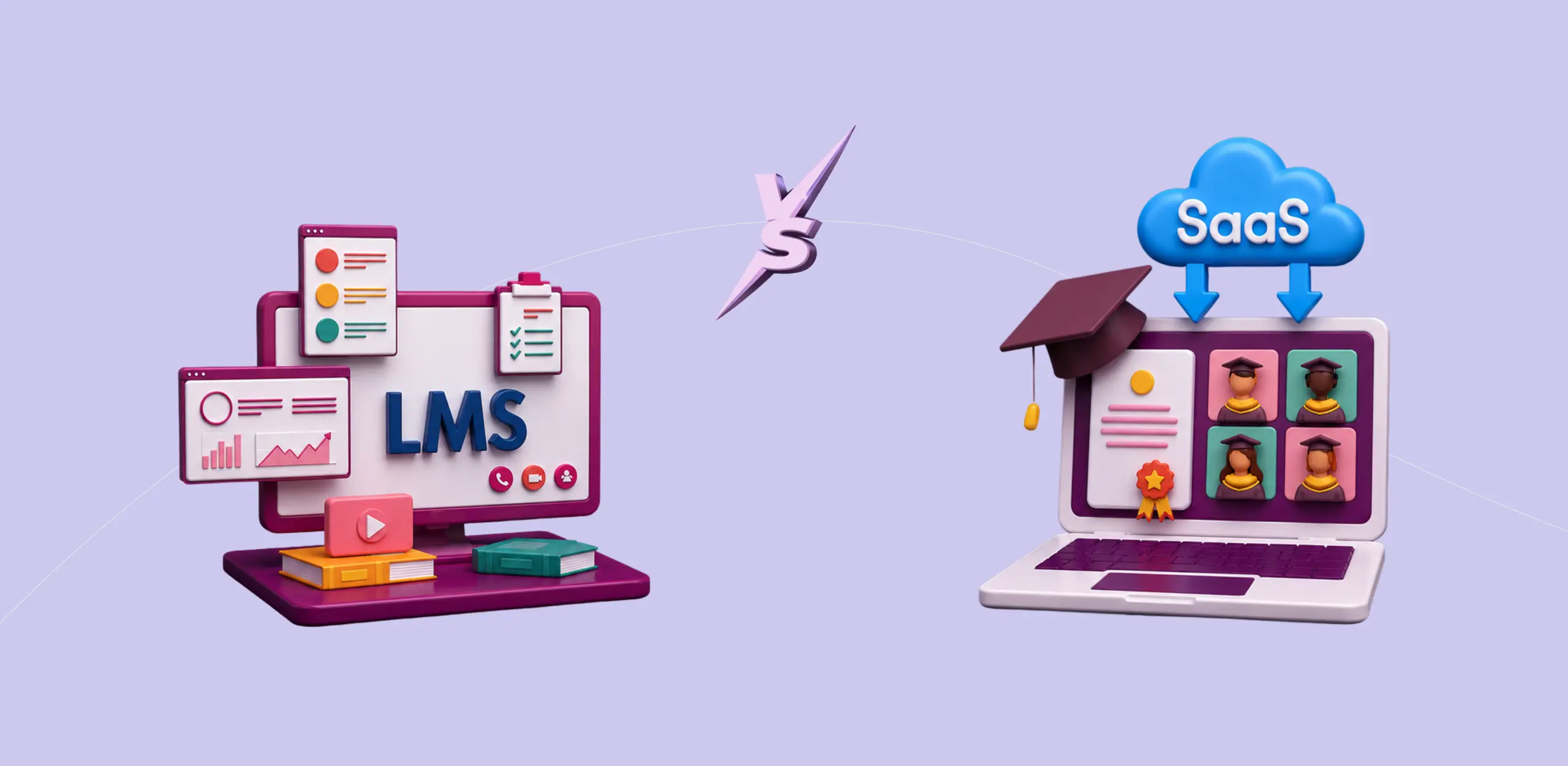
Most businesses do not outgrow their learning platform in one dramatic moment. They outgrow it slowly, as users increase, integrations become harder, reporting expectations rise, and learning becomes more connected to business performance. That is when Custom LMS Development starts becoming a serious alternative to a standard SaaS LMS platform.
A SaaS LMS platform is often the fastest way to launch. It can help teams upload courses, assign learners, issue certificates, and track completion without a heavy implementation effort. But speed is not the only metric that matters in 2026. Enterprises now need learning systems that support role-based pathways, customer education, compliance evidence, multilingual delivery, AI tutors, predictive analytics, and secure data governance.
The real question is not whether SaaS is good or whether custom is always better. The real question is whether learning is becoming a strategic system inside your organisation. If the LMS only manages standard internal training, SaaS may be enough. If it supports revenue, risk control, workforce readiness, partner enablement, or product-led education, a tailored platform may deliver stronger long-term value.
Key Takeaways
- Choose a SaaS LMS when speed, standard workflows, and lower upfront cost matter more than deep control.
- Choose custom LMS development when integrations, AI, data ownership, compliance, multi-tenancy, or differentiated learning experiences are strategic.
- For large user bases, the decision should be evaluated through five-year total cost of ownership, not year-one subscription pricing alone.
Build an LMS That Grows With You
Why Does the LMS Decision Matter More in 2026?
The LMS is no longer just a place to host videos, PDFs, quizzes, and certificates. For enterprises, EdTech companies, universities, healthcare networks, and training providers, the LMS is becoming a digital infrastructure layer. It connects learning data, business systems, content operations, learner engagement, compliance reporting, and AI-led support.
According to Fortune Business Insights, the global learning management system market is projected to grow from USD 31.61 billion in 2026 to USD 104.04 billion by 2034. Grand View Research estimates the AI in education market at USD 11.4 billion in 2026, with a forecast of USD 57.2 billion by 2033. These figures show why learning platforms are moving from administrative tools to intelligent learning ecosystems.
Before selecting a platform, decision-makers should ask:
- Will the LMS support future user growth, not only the first launch?
- Can it integrate with HRMS, CRM, ERP, SIS, SSO, payment, content, and analytics systems?
- Does the organisation need full control over learner data, audit logs, and reporting models?
- Will AI tutors and recommendations need to use internal content safely?
- Will the five-year cost model still make sense at scale?
Custom LMS vs SaaS Platform: At a Glance
This table gives a quick decision-maker view before the deeper analysis.
Strategic Dimension | SaaS LMS Platform | Custom LMS Development |
Launch Velocity | Days to weeks; works well for fixed workflows. | Months; built around existing architecture and roadmap. |
UX & Workflow Control | Limited to vendor templates, feature tiers, and configuration options. | Full control over learner journeys, roles, dashboards, and workflows. |
Financial Engine | OPEX model with low upfront cost and compounding subscription fees. | Higher initial investment with lower dependency on recurring user licences. |
Data Governance | Data export and raw access depend on vendor APIs and policies. | Full control over data schema, logs, retention, and governance rules. |
AI Integrations | Generic AI features shaped by vendor roadmap. | Domain-specific RAG pipelines using internal content and guardrails. |
When Is a SaaS LMS the Right Choice for an Enterprise?
A SaaS LMS is the right choice when the learning requirement is standard and speed-to-launch matters more than deep customisation. It gives teams a ready-made system for course delivery, learner enrolment, certificates, basic reporting, and admin workflows.
This is usually the best fit for organisations that can adapt their process to the platform instead of expecting the platform to adapt to them.
- Internal training programmes with standard course structures.
- Small to mid-sized teams that need fast onboarding.
- Basic compliance training with completion tracking.
- Teams with limited integration, AI, or custom reporting needs.
- Organisations that prefer subscription-based operating expenditure over upfront build cost.
The limitation usually appears later. As learning operations grow, teams may need custom analytics, deeper integrations, branded journeys, multilingual workflows, advanced access controls, or AI features that a vendor roadmap cannot prioritise quickly.
When Should You Choose Custom LMS Development?
Custom LMS development becomes the stronger choice when the learning platform must behave like a business system, not just a course library. This is common when learning directly supports compliance, revenue, customer education, workforce capability, partner enablement, or product-led growth.
A custom learning management system is especially relevant when the organisation has unique workflows that cannot be simplified without hurting adoption, governance, or business outcomes.
- Role-based learning journeys for employees, customers, partners, instructors, managers, and tenant admins.
- Deep LMS integration services with HRMS, CRM, ERP, SIS, SSO, payment gateways, analytics tools, and video infrastructure.
- Enterprise LMS development for multi-region, multi-brand, or multi-tenant learning operations.
- Custom dashboards for skills, engagement risk, assessment performance, compliance evidence, and content effectiveness.
- Secure AI tutors, personalised recommendations, and knowledge assistants trained on approved internal content.
For organisations planning a broader digital learning product, Enfin’s e-learning app development services can support LMS platforms, virtual classrooms, learner analytics, content workflows, and scalable education products. Enfin also brings custom software development expertise when the LMS must operate as long-term business infrastructure.
What Is the Real Cost Difference Between SaaS LMS and Custom LMS?
Cost comparison is where many LMS decisions become misleading. SaaS appears cheaper in year one because there is no major upfront build. But subscription fees scale with users, storage, support tiers, premium analytics, API access, and feature-gated upgrades.
As an illustrative calculation, if a SaaS LMS platform costs USD 6 per active user per month, 500 users cost USD 36,000 per year. At 5,000 users, the same pricing becomes USD 360,000 annually. At 10,000 users, it becomes USD 720,000 annually before considering premium modules, migration, integrations, storage, and support.
Scenario | SaaS LMS Cost | Custom LMS Cost | Decision Note |
500 active users | Approx. USD 36,000/year at USD 6/user/month. | May not justify full custom build unless workflows are complex. | SaaS often wins on speed and cost. |
5,000 active users | Approx. USD 360,000/year before add-ons. | Custom build may become viable depending on scope and integrations. | Evaluate five-year TCO. |
10,000 active users | Approx. USD 720,000/year before premium modules. | Custom ownership can reduce licensing dependency over time. | Custom evaluation becomes serious. |
A fair comparison must also include the custom side. Custom LMS development is not maintenance-free. Businesses should budget for cloud hosting on AWS or Azure, security monitoring, backups, dependency upgrades, penetration testing, SLA support, feature enhancements, and post-launch maintenance. A practical planning assumption is annual maintenance at 15-20% of the initial development cost, depending on the platform scope and support model.
For budgeting, many enterprise teams should treat a custom LMS as a phased product investment rather than a one-time website build. A focused MVP may take around 12-20 weeks, while a full enterprise LMS with multi-tenancy, AI, integrations, security controls, and analytics can take 4-8+ months. Starting investment varies widely by geography, scope, compliance requirements, and engineering depth, but the key is to compare it against three-to-five-year SaaS spend, not only year-one cost.
For organisations scaling beyond roughly 3,000 active users, an illustrative model may show break-even within 18-24 months after launch when SaaS licensing, premium modules, and integration fees are compared against a scoped custom build. This is not a universal rule. It should be validated with actual user volume, licensing quotes, cloud estimates, maintenance assumptions, and roadmap priorities.
How Is an Enterprise AI Tutor Different from a Basic OpenAI Wrapper?
Many platforms now promote AI tutors, automated quiz generation, and smart recommendations. But enterprise buyers should look beyond the feature label. A simple AI wrapper sends user questions to a large language model and returns a generic answer. A serious AI-powered LMS must connect AI to approved content, access rules, learning history, assessment context, and governance workflows.
This is where Retrieval-Augmented Generation, or RAG, becomes important. In a RAG-based LMS, approved internal learning material is indexed into a vector database. When a learner asks a question, the AI system retrieves the most relevant internal content first, then generates an answer grounded in that approved source material. This reduces hallucination risk and keeps the AI tutor aligned with curriculum, compliance rules, and enterprise IP.
In a stronger LMS software development approach, the AI layer should include:
- Vector database matching for internal content, policies, course modules, and knowledge documents.
- RAG pipelines that retrieve approved learning material before generating responses.
- Role-based access control so learners only receive answers from content they are permitted to view.
- Privacy guardrails, encryption, retention policies, audit logs, and human review workflows.
- Feedback loops to improve answer quality, flag weak content, and monitor AI reliability over time.
Enfin can support this through AI development services that connect AI models with product architecture, data governance, learning workflows, and secure enterprise deployment rather than treating AI as a standalone chatbot.
What Security and Interoperability Standards Should an Enterprise LMS Support?
For enterprise buyers, the LMS decision is also a security, compliance, and interoperability decision. A platform may look impressive in a demo but fail during procurement if it cannot support content portability, identity management, audit trails, or secure integrations.
A serious enterprise LMS roadmap should evaluate SCORM support for e-learning content packaging, xAPI support for broader learning experience tracking, and LTI 1.3 compliance for secure integration with external learning tools. It should also consider SSO through SAML, OAuth, or OpenID Connect; role-based access; encryption; audit logs; data retention; and SOC 2 Type II readiness or equivalent controls.
This matters because custom LMS development gives organisations control over the data model, access logic, evidence trails, and integration architecture. Instead of forcing the business into vendor-defined workflows, the platform can be designed around procurement, compliance, learner privacy, and operational reporting needs.
The LMS Maturity Journey: When Does Migration Become Necessary?
The right platform choice depends on where your organisation sits in the learning maturity journey. This framework helps CTOs, CFOs, and L&D leaders identify when SaaS remains practical and when custom evaluation becomes important.
Phase | Stage | Operational Reality | Likely Platform Fit |
Phase 1 | Standardised Training | Course delivery, completion tracking, basic certificates. | SaaS usually fits. |
Phase 2 | Structured Workflows | Role-based paths, compliance audits, advanced reporting. | SaaS may face friction. |
Phase 3 | Integrated Enterprise | Deep HRMS, CRM, ERP, SSO, and analytics integration. | Custom evaluation becomes critical. |
Phase 4 | Learning as a Strategic Engine | Customer education, partner training, LTV impact, external monetisation. | Tailored platform creates differentiation. |
Phase 5 | Intelligent Ecosystem | Secure AI tutors, predictive analytics, adaptive learning, governance rules. | Purpose-built architecture is preferred. |
LMS Software Development Requirements Before You Build
Before selecting an LMS development company, teams should define product requirements clearly. This prevents the project from becoming a feature wishlist and helps estimate cost, architecture, timeline, and integration complexity.
- User roles: learner, instructor, admin, manager, partner, customer, or tenant admin.
- Learning model: self-paced, live, blended, cohort-based, certification, compliance, or customer education.
- Content strategy: SCORM, xAPI, video, assessments, documents, simulations, or AI-assisted support.
- Analytics: completion, engagement, skills, assessment performance, learner risk, and business ROI.
- Architecture: single-tenant, multi-tenant, white-label, API-first, mobile-first, or enterprise deployment.
If live classes, breakout rooms, whiteboards, recordings, or low-latency collaboration are part of the learning model, Enfin’s WebRTC app development services can support real-time virtual classroom experiences inside the LMS ecosystem.
Should You Build, Subscribe, or Evaluate Both?
Use this simplified decision logic before committing to a platform path.
- Choose SaaS when speed, standard workflows, and low upfront cost matter more than long-term customisation.
- Evaluate both when user volume is growing, integrations are increasing, and future AI or analytics needs are unclear.
- Choose custom LMS development when learning data, workflows, integrations, AI, security, or monetisation are strategic.
For example, a small internal training team may not need a custom build. But a healthcare training provider with compliance reporting, role-based access, video consultations, audit logs, and AI-assisted learning support should evaluate custom ownership seriously.
Custom LMS Development Implementation Checklist for LMS Buyers
Before choosing a SaaS LMS platform or moving into Custom LMS Development, use this checklist to protect the original business and technical intent.
- Custom LMS Development should start with role mapping for learners, instructors, admins, partners, customers, and tenant admins.
- Custom LMS Development should define the custom learning management system model before interface design begins.
- Custom LMS Development should document LMS software development standards such as SCORM, xAPI, LTI 1.3, and SSO.
- Custom LMS Development should map LMS integration services across HRMS, CRM, ERP, SIS, payments, analytics, and video systems.
- Custom LMS Development should clarify whether the roadmap is an enterprise LMS development project with multi-tenant requirements.
- Custom LMS Development should define if the product is a corporate training LMS, EdTech platform, or customer education system.
- Custom LMS Development should specify AI-powered LMS use cases such as RAG tutors, vector search, recommendations, and learner-risk analytics.
- Custom LMS Development should confirm whether the existing SaaS LMS platform can meet these needs without heavy workaround costs.
- Custom LMS Development should include Day 2 ownership: hosting, security monitoring, SLA support, backups, and roadmap planning.
- Custom LMS Development should be led by an LMS development company with product engineering, governance, and maintainability experience.
The right LMS development company should also define LMS software development scope, LMS integration services, enterprise LMS development risks, the corporate training LMS governance model, and AI-powered LMS architecture. This keeps the custom learning management system practical, measurable, and easier to scale.
This does not mean Custom LMS Development is automatically the right path. It means the right LMS development company should evaluate Custom LMS Development only when the corporate training LMS or AI-powered LMS strategy has become business infrastructure.
For complex enterprise LMS development, LMS integration services, corporate training LMS, and AI-powered LMS planning, discovery should happen before build.
Conclusion: The Right LMS Choice Depends on What Learning Means to Your Business
SaaS LMS platforms are valuable when the learning need is standard, the team needs speed, and the organisation can work within vendor-defined workflows. They reduce launch friction and provide a practical starting point for many businesses.
Custom LMS development becomes the stronger choice when the platform must support differentiated learning journeys, deep integrations, AI-powered learning, full data ownership, enterprise security, and long-term product control. The decision should not be based only on upfront cost. It should be based on scale, governance, learning value, total cost of ownership, and strategic importance.
The most important question is not whether SaaS or custom is universally better. The question is whether learning is becoming a strategic capability for your organisation. If the answer is yes, the LMS should be evaluated as digital infrastructure, not just training software.
Build a Future-Ready LMS with Enfin Technologies
Enfin Technologies helps organisations design and develop scalable learning platforms that connect product engineering, AI, analytics, real-time communication, secure integrations, and user-centred learning experiences. Whether you are modernising an internal LMS, launching an EdTech platform, or building a customer education ecosystem, Enfin can help you plan the right architecture and roadmap. Talk to Enfin about your LMS project.
Let’s transform your business for a change that matters!
F. A. Q.
Do you have additional questions?
What is custom LMS development?
Custom LMS development is the process of designing and building a learning management system around an organisation’s specific workflows, integrations, learner roles, data requirements, branding, security needs, and long-term product roadmap.
Is a SaaS LMS better than a custom LMS?
A SaaS LMS is better for fast deployment and standard training needs. A custom LMS is better when learning workflows, AI, data ownership, compliance, integrations, or monetisation are strategic.
When should a business choose custom LMS development?
A business should choose custom LMS development when the LMS must integrate with enterprise systems, support multi-tenant learning, provide advanced reporting, enable domain-specific AI tutors, or support differentiated learning journeys.
How does RAG improve an AI-powered LMS?
RAG improves an AI-powered LMS by grounding answers in approved internal content. The AI tutor retrieves relevant course material, policy documents, or knowledge resources before generating a response, reducing generic or inaccurate answers.
What are the hidden costs of custom LMS ownership?
Custom LMS ownership can include cloud hosting, security monitoring, maintenance, support agreements, compliance reviews, backups, performance optimisation, and feature enhancements after launch.
Why are SCORM, xAPI, and LTI important in LMS software development?
SCORM supports content interoperability, xAPI tracks broader learning experiences, and LTI 1.3 enables secure integration with external learning tools. These standards help an LMS work across content, tools, and enterprise systems.
How long does custom LMS development usually take?
Custom LMS development timelines depend on the scope, integrations, user roles, AI requirements, and compliance needs. A focused MVP can usually take around 12–20 weeks, while a full enterprise LMS with multi-tenancy, analytics, AI tutors, SSO, and third-party integrations may take 4–8+ months.
Can a business migrate from a SaaS LMS to a custom LMS later?
Yes. Businesses can migrate from a SaaS LMS to a custom LMS, but the complexity depends on data export options, content formats, learner records, assessment history, certificates, integrations, and vendor restrictions. This is why data ownership and migration planning should be evaluated before choosing any LMS platform.
Is custom LMS development suitable for small businesses?
Custom LMS development may not be necessary for every small business. If the requirement is basic course delivery, user management, and completion tracking, a SaaS LMS platform may be more practical. A custom LMS becomes more valuable when the business needs unique workflows, branded learning experiences, integrations, monetisation, or long-term product control.
What should companies check before hiring an LMS development company?
Companies should evaluate the LMS development company’s experience in product engineering, e-learning app development, integrations, cloud architecture, security, AI implementation, analytics, and scalable platform development. It is also important to check whether the team understands SCORM, xAPI, LTI, SSO, data privacy, and post-launch maintenance.